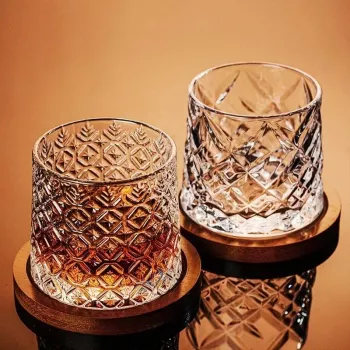
Spinning whiskey glasses are designed to gently rotate on a rounded base, creating a smooth swirl of the spirit without needing a vigorous wrist motion. That subtle spin helps aerate whiskey—mixing in a bit of oxygen—so aromas open up faster and become easier to pick out as you nose the glass.
The motion also encourages a consistent coating of whiskey along the inside walls. That can make it simpler to observe “legs” (the droplets that form as the liquid runs back down), which many people enjoy as part of the tasting ritual, even if it’s not a direct measure of quality. For drinkers who like taking their time, the spinning action turns a standard pour into a more interactive, sensory experience.
A traditional swirl in a flat-bottomed glass can splash or over-agitate higher-proof pours. A spinning glass aims for controlled movement: it keeps the whiskey circulating while staying low and steady, which can feel more refined for careful nosing. This is especially handy when tasting subtle differences between bottles or sampling a new pour.
Many spinning whiskey glasses are chosen because they look striking on a bar cart and invite guests to engage with the drink. The visual effect isn’t only decorative—it supports a tasting-style pour by encouraging slow sipping and attention to aroma and finish.
Spinning glasses are popular with whiskey hobbyists, gift shoppers, and anyone building a home bar. They can also be useful for casual tastings with friends, where the spin helps highlight aroma notes without needing specialized technique.
For a deeper look at how they work, what to expect, and how to use them comfortably, visit https://pantrypulse.shop/what-are-spinning-whiskey-glasses-for/.
They don’t change the whiskey itself, but the added aeration can make certain aromas more noticeable, which may influence perceived flavor. The effect is usually subtle and depends on the pour, proof, and how long you let it spin.










Leave a comment